 LoneStarMap
Tick species • Field guide
Lone Star tick (Amblyomma americanum)
The Lone Star tick (Amblyomma americanum) is an aggressive, fast-moving human-biting tick found across the eastern, southeastern, and south-central United States. The adult female is unmistakable: a reddish-brown body with a single bright white or cream dot in the center of the back — the "lone star." Males, nymphs, and the tiny larvae do not have that dot, so the marking only helps you identify adult females. Unlike the blacklegged (deer) tick, the Lone Star tick does not spread Lyme disease. It is, however, the main US cause of alpha-gal syndrome (a red-meat allergy) and can transmit ehrlichiosis, Heartland and Bourbon viruses, tularemia, and is associated with the STARI rash. This page is educational and is not a substitute for medical care — see a clinician about any bite, rash, or symptoms.
Last reviewed: 2026-07-20 · Educational only — not medical advice.
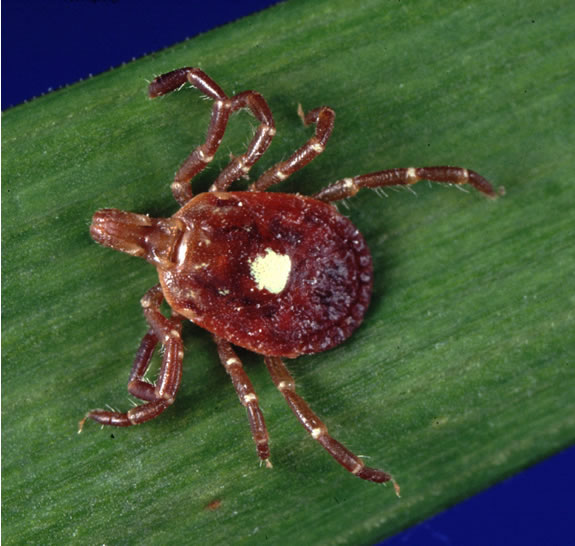
How to identify it
- Adult female: reddish-brown body with one distinct, slightly iridescent white/cream dot in the center of the scutum (back) — the diagnostic 'lone star.'
- Adult male: darker reddish-brown with no single central dot; instead there are scattered white spots and streaks around the rear and outer margin of the body.
- Long mouthparts (a long capitulum) that clearly project forward — noticeably longer than the short mouthparts of Dermacentor 'dog' ticks; a useful clue on males, nymphs, and larvae that lack the dot.
- Festoons: a row of small rectangular blocks separated by grooves along the rear edge of the body, present in Amblyomma nymphs and adults.
- Rounded, teardrop-shaped body and relatively long legs; the overall look is 'roundish' rather than the flat, narrow silhouette of a blacklegged tick.
- Nymphs and larvae are unmarked and easily confused with other species — the white dot does not apply to them.
Size: Larva (six legs, the "seed tick"): about 0.5 mm, roughly a pinhead or grain of sand. Nymph (eight legs): about 1–1.5 mm, close to a poppy seed. Unfed adult: about 3–4 mm, roughly a sesame seed, with the female slightly larger than the male. Engorged (fully fed) female: swells dramatically to about 10–16 mm — pea- or small-grape-sized — turning slate-gray or olive; females may take a week to 10 days or more to fully engorge.
Where it lives & when
CDC maps the Lone Star tick as widely distributed through the Northeast, South, and Midwest of the United States. Its core, long-established range runs from Texas and Oklahoma eastward across the South-Central and Southeastern states to the Atlantic coast, and up the coastal plain into the mid-Atlantic and southern New England. Surveillance and university-extension data document ongoing northward and westward expansion — reported as far north as Maine and as far west as parts of Colorado and Wyoming — attributed partly to rebounding white-tailed deer populations. A county not marked "established" does not mean the tick is absent there.
Season: Active from spring through fall, with a longer season in the warm South. Adults are most active roughly April through late August; nymphs are common late spring into summer (about May–July); and larvae — the swarming "seed ticks" that can attach by the dozens or hundreds — peak in mid-to-late summer. All three biting stages (larva, nymph, adult) will bite people, and this species quests actively and moves quickly toward a host.
- Woodlands with dense, brushy undergrowth and the shaded transition zones between forest and field
- Tall grass, weedy field borders, fence lines, and overgrown trail edges
- Around animal resting and bedding areas — especially white-tailed deer and wild turkey habitat
- Leaf litter and low vegetation in humid, shaded ground cover
- Suburban yards and edges bordering woods or brush where deer and small mammals travel
Diseases the lone star tick can carry
Tick presence is not the same as personal disease risk. Not every bite transmits a pathogen.
Look-alikes
Honest confusion is common outside the adult-female stage. The American dog tick (Dermacentor variabilis) is a frequent mix-up: it is a similar size but has an ornate white-to-gray mottled/marbled shield rather than a single dot, and much shorter mouthparts — the female Lone Star's one clean central dot versus the dog tick's patterned shield is the tell. The Gulf Coast tick (Amblyomma maculatum), a close relative that overlaps in the Southeast, is larger with more extensive silvery ornamentation spread across the shield rather than a single spot. Blacklegged/deer ticks (Ixodes scapularis) are much smaller, darker, and have no white dot — worth distinguishing because people often fear Lyme, which the Lone Star tick does not transmit. Critically, male Lone Star ticks (streaks, not a dot) and all nymphs and larvae lack the star, so the classic marking only confirms adult females; use body shape, long mouthparts, and festoons for the other stages, and consider photographing the tick or asking a clinician or extension service for identification.
Compare all tick species →Lone Star tick — frequently asked questions
What does a Lone Star tick look like?+
The easiest sign is on the adult female: a reddish-brown body with a single bright white or cream dot in the center of the back. Males have scattered white streaks around the edge (no single dot), and nymphs and larvae are tiny and unmarked. Long, forward-projecting mouthparts and a rounded body help identify the stages that lack the dot.
Does the Lone Star tick cause Lyme disease?+
No. The Lone Star tick is not considered a vector of Lyme disease, which is spread by blacklegged (deer) ticks. A round, expanding rash after a Lone Star bite may instead be STARI (Southern tick-associated rash illness), which is not Lyme. Have any rash or symptoms evaluated by a clinician.
Can a Lone Star tick bite cause a red-meat allergy?+
Yes. In the United States the Lone Star tick is the tick most often associated with alpha-gal syndrome (AGS), an allergy to a sugar (alpha-gal) found in mammalian meat and products. After sensitization, people can react hours after eating red meat such as beef, pork, or lamb. AGS is diagnosed and managed by a clinician.
What diseases does the Lone Star tick actually carry?+
It can transmit ehrlichiosis (from Ehrlichia chaffeensis and E. ewingii), Heartland virus, Bourbon virus, and tularemia, is the tick linked to the STARI rash, and is the main US tick associated with alpha-gal syndrome. It is not a primary vector of Rocky Mountain spotted fever, anaplasmosis, babesiosis, Powassan virus, or Lyme disease.
Does the Lone Star tick spread Rocky Mountain spotted fever?+
It is not considered a primary vector. Most US RMSF is spread by the American dog tick, Rocky Mountain wood tick, and brown dog tick — and despite the name, most reported cases are in South-Central states such as Arkansas, Oklahoma, Missouri, Tennessee, and North Carolina.
How fast should I remove a Lone Star tick?+
Promptly. Use fine-tipped tweezers to grasp the tick close to the skin and pull straight out with steady pressure, then clean the area. Save or photograph the tick if you can, and contact a clinician if you develop fever, rash, aches, or other symptoms in the days to weeks after a bite.
Sources used
- Where Ticks LiveCDC
The Lone Star tick is widely distributed in the Northeast, South, and Midwest U.S.
- Lone Star Tick SurveillanceCDC
County-level established vs. reported records. 'Established' = 6+ ticks or multiple life stages collected in 12 months.
- EhrlichiosisCDC
Bacterial illness transmitted primarily by the Lone Star tick; treatable with prompt antibiotics.
- Heartland VirusCDC
Rare virus associated with Lone Star tick bites; no specific antiviral treatment.
- Bourbon VirusCDC
Rare tickborne virus first identified in the U.S. in 2014; supportive care only.
- TularemiaCDC
Bacterial illness that can be spread by tick bites (including the Lone Star tick) and other routes.
Share card
Lone Star tick (Amblyomma americanum)
Identify the Lone Star tick by the female's single white dot and long mouthparts. See its US range, life stages, seasons, and the diseases it actually carries — ehrlichiosis, STARI, Heartland and Bourbon virus, tularemia, and alpha-gal syndrome. It does not cause Lyme. Educational, not medical advice.